


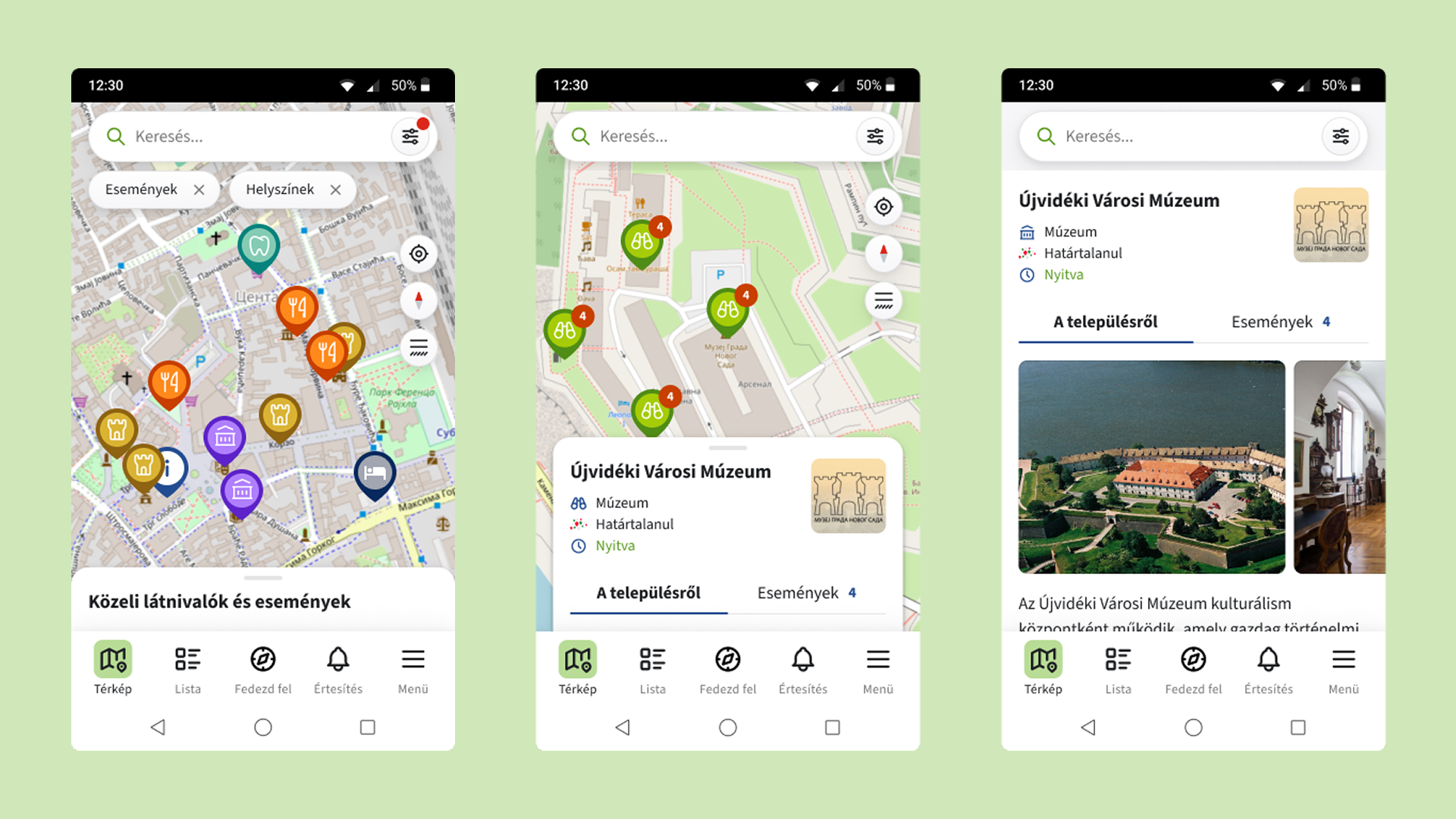
Hello Vajdaság is a production mobile application focused on the Vojvodina region, aggregating events, accommodations and local points of interest primarily for tourists and local users. The project was built on the geospatial foundation developed for Natur Digital, extending a proven map architecture with event-centric functionality, content freshness rules and fast search powered by Typesense.
A key focus of the project was ensuring content accuracy: only active events should be visible, outdated listings must be removed automatically and new updates must appear consistently across the system.
Unlike a purely location-based application where content is mostly static, Hello Vajdaság places strong emphasis on time-sensitive event data such as concerts, festivals, exhibitions, and sports matches. This shifts the primary complexity from “what exists” to “what is currently relevant”.
The application had to support:
- Frequent content changes (new events, updated details, removed items)
- Clear rules for event visibility based on dates and status
- A user experience that remains accurate without manual refresh behavior
The main technical challenges of the project were related to data correctness and continuous updates:
- Ensuring only active events are visible while expired events are removed automatically
- Keeping listings consistent across mobile and backend as content changes frequently
- Implementing reliable background refresh and cache invalidation logic
- Rendering event-driven content efficiently without stale or duplicated state
- Supporting fast search and filtering for frequently updated datasets
Because content was changing constantly, correctness mattered more than “nice-to-have” UI behavior. The system needed predictable rules for when and how data becomes visible to users.
The project uses the same core stack as the related map-based foundation:
- React Native for the mobile application
- Node.js + Drupal for backend and content management
- MongoDB for data storage
To support event-centric behavior, the architecture emphasized:
- Strong separation between cached data and “freshness” validation
- Deterministic visibility rules for event-based content
- Background refresh strategies designed to minimize stale content
For search functionality, the project used Typesense as a lightweight and fast alternative to Elasticsearch. This was particularly useful for frequently changing event datasets where responsiveness and quick filtering are core user expectations.
Users can explore content through map-based and list-based views, focusing on what is relevant for the current time and location. The application highlights:
- Active events based on current date and event duration
- Points of interest and accommodations for trip planning
- Search and filtering designed for quick discovery
Event visibility is driven by predefined rules to ensure that users do not see expired or outdated information.
Because the application handles time-sensitive listings, reliability was primarily defined as content correctness rather than only network stability.
The system was built to ensure:
- Expired content is removed from user-facing views automatically
- Newly added or updated items become visible without long delays
- Cached data does not cause incorrect event visibility
- Updates remain consistent between mobile and backend interfaces
Hello Vajdaság required building a production system where the main challenge is keeping dynamic content accurate over time.
Key areas of experience gained include:
- Designing deterministic event visibility rules
- Managing frequently changing data with caching and background refresh logic
- Maintaining consistency between mobile and backend systems
- Implementing fast search for dynamic, time-sensitive datasets
The project demonstrates a practical focus on correctness, maintainability, and reliable user-facing information.